 blog
Are Delivered Wings and Burgers Still Safe to Eat?
Last Updated: November 16, 2026
Quick Summary
Spoiled delivery food usually shows warning signs you can see and smell: a sour, rotten or ammonia-like odor, gray or green discoloration, fuzzy mold, a slimy coating, or a leaking or bulging container. Because delivery food can sit too long in the danger zone, check packaging and temperature before eating, and never taste food to test it.
- Hot food should stay at 140 °F or above, and cold perishable food at 40 °F or below.
- Perishable takeout is generally safe for about two hours at room temperature.
- Do not taste food to check whether it is safe, since some bacteria change neither taste nor smell.
- Discard mold-affected buns, cheese or sauces entirely, not just the visible spot.
- Keep the food, packaging and receipt, and report problems to the restaurant and delivery service.
Table of Contents
- Why Delivered Food Spoils Faster Than You Think
- Signs of Food Spoilage You Can See and Smell
- Safe Temperature for Hot Food Delivery
- How Long Can Takeout Sit Out Before It Is Unsafe?
- A Delivery Inspection Checklist Before You Eat
- What to Do After Eating Spoiled Food
- Next Time Your Order Arrives: What to Check First
- Frequently Asked Questions
Why Delivered Food Spoils Faster Than You Think
A hot order can turn into a problem quickly once it is sitting on a doorstep.
Delivery adds time, and time is the main enemy of safe food. An order can sit in a warm car, on a porch, or in a lobby before anyone opens the bag.
- Cooked meat and poultry are among the most perishable foods
- Sauces, cheese and cut vegetables can break down faster than they look
- Steam trapped inside a sealed container keeps food warm and moist, which bacteria like
If you have ever wondered whether that cold burger is still fine, you are asking the right question. Find a reliable late-night burger delivery option near you if you need a replacement order.
Signs of Food Spoilage You Can See and Smell
Most spoiled food gives off warning signs. The trouble is that some of those signs show up late, and some are easy to miss in a dim room with a game on. Use your senses as a first check, but do not rely on them alone.
Unusual or Foul Odors
A sour, rotten, or ammonia-like smell is a clear reason to throw food out. Wings and burgers should smell like seasoning and cooked meat. Any sharp or off smell means the food should not be eaten.
- Sour or vinegar-like smell on chicken or dairy sauces
- Rotten egg or sulfur smell from meat
- Strong ammonia smell from fried or grilled items
Do not taste food to check whether it is safe. Some bacteria cause illness without changing taste or smell.
Color Changes, Mold and Visible Spots
Look for color that is clearly wrong. Chicken that looks gray or green, or a burger patty with a dull, slimy surface, is past its best. Any fuzzy growth, dark spots, or colored patches on bread, cheese, or sauces means the whole item should be discarded.
- Gray or green tint on cooked chicken or beef
- Fuzzy white, green, or black mold on buns, cheese, or sauces
- Dark spots spreading across the food
Sliminess, Leaking and Bulging Containers
Texture changes are a strong sign. Food that feels slick or sticky after cooking has likely spoiled. Check the container too. A leaking box, a torn seal, or a puffed-up lid can mean gas is building inside.
- Slimy coating on wings or meat
- Liquid leaking through the box or bag
- Bulging lids or containers that hiss when opened
Damaged packaging also raises a safety concern.
Use this quick guide to spot warning signs before you eat delivered food.
| Sign | What it may mean | Action |
|---|---|---|
| Sour, rotten or ammonia-like smell | Bacterial growth | Throw food out |
| Gray or green tint on cooked chicken or beef | Spoilage | Discard |
| Fuzzy white, green or black mold | Mold growth on buns, cheese or sauces | Discard the whole item |
| Slimy coating on wings or meat | Spoilage | Discard |
| Leaking box or torn seal | Possible gas or contamination | Do not eat |
| Bulging lid or hissing container | Gas building inside | Do not eat |
| Do not taste food to check | Some bacteria change neither taste nor smell | Rely on the signs, not tasting |
Safe Temperature for Hot Food Delivery
Hot food should stay hot during delivery, and cold food should stay cold. Food safety guidance generally recommends keeping hot food at 140 °F or above, and cold perishable food at 40 °F or below (the FDA).
How to spot temperature abuse in delivery packaging:
- Feel the outside of the bag and container. Food that feels lukewarm after a long trip may have dropped into the danger zone.
- Check for condensation inside the bag. Heavy moisture can mean food has been sitting too long or was not kept hot enough.
- Smell the food as soon as you open it. A sour smell points to bacterial growth.
- Look at cheese and sauces. Melted or separated sauce can mean the food was held at an unsafe temperature.
Cooked meat is generally best eaten within two hours of cooking, or within one hour when it is very hot outside. That window is shorter than many people expect.
How Long Can Takeout Sit Out Before It Is Unsafe?
Perishable takeout is generally safe for about two hours at room temperature. After that, bacteria can multiply to levels that cause illness. Heat from reheating does not always undo that growth.
A common mistake is leaving food in the car while running other errands. Another is saving half a burger for the next day without refrigerating it fast. Put leftovers in the refrigerator within two hours, and eat them within three to four days.
A Delivery Inspection Checklist Before You Eat
Most spoilage advice assumes you cooked the food yourself. Delivery is different: the food has already traveled, changed hands, and sat in packaging you did not control. Work through it in order, packaging first, then temperature, then the food itself, because a failure early in the sequence makes the later checks moot. Review a full set of food quality standards to see what a well-run kitchen should deliver.
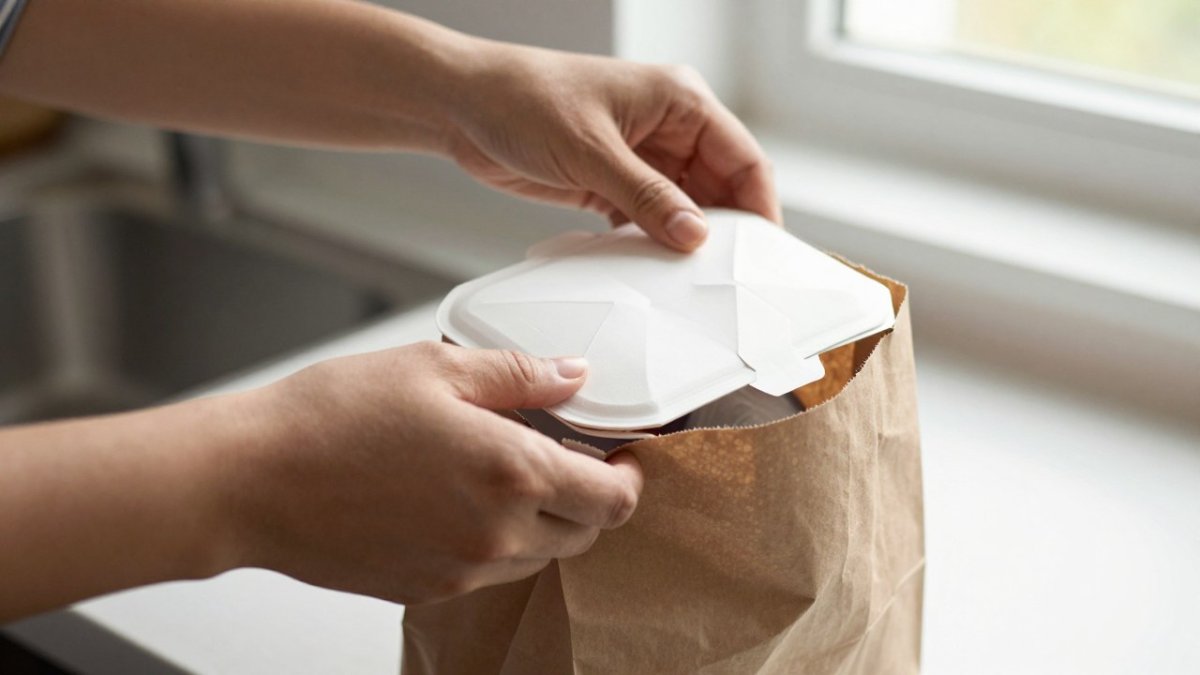
Step 1: Inspect the packaging before you open anything
- Check that every container lid is fully seated and that any tamper-evident seal, sticker, or shrink band is intact. A broken seal or a lid that lifts without resistance means the food may have been opened or handled after it left the kitchen.
- Look for spills, grease rings, or liquid pooling in the bottom of the bag. Leakage can mean a container tipped, cracked, or was never sealed properly, and cross-contamination between items is possible once liquids move.
- Note crushed, punctured, or dented containers. A punctured lid lets air and contaminants in.
Step 2: Check temperature by touch and by item
- Feel the side of each container, not just the bag. Hot items should feel hot through the packaging; cold items should feel distinctly cold. A lukewarm container after a short trip is a warning sign.
- Check the most perishable items first: cooked meat and poultry, seafood, rice, dairy-based sauces, and cut produce. These are the items most likely to have spent time in the danger zone.
- Look at cheese and cream sauces for separation, curdling, or a skin forming on top, all can indicate the food was held at an unsafe temperature.
Step 3: Inspect the food itself, item by item
- Cooked meat and poultry: gray or green tint, a dull or slick surface, or any slimy coating.
- Burgers and fried items: a soggy, greasy texture that feels wet rather than crisp can mean trapped steam and a long hold time; combine that with an off smell and discard.
- Rice and grains: any sour or fermented smell, or a sticky, clumped texture beyond what the dish normally has.
Step 4: Decide and document
If any item fails a check, do not eat it and do not taste it to confirm. Photograph the packaging, the seal, and the food in the same frame if possible, note the delivery time, and contact the restaurant or delivery service before you discard anything.
A checklist cannot prove food is safe. Because appearance cannot rule out contamination, knowing how to identify truly fresh delivered meals can help you judge quality without treating freshness as proof of safety.
What to Do After Eating Spoiled Food
If you suspect you ate spoiled delivery food, the response has two tracks: your health now, and the record you build for later. Handle the health track first, but do not throw anything away until you have documented the order.
If you feel sick
Food poisoning symptoms typically begin within hours of eating, though some pathogens take longer. Common signs include nausea, vomiting, stomach cramps, diarrhea, and fever. Most cases resolve on their own within a few days.
- Drink fluids to replace what you lose to vomiting or diarrhea. Oral rehydration solutions are more effective than water alone for significant fluid loss.
- Do not force yourself to eat; reintroduce bland food when you feel able.
- Seek medical care promptly if you have a high fever, bloody stool, severe abdominal pain, signs of dehydration (dizziness, dry mouth, little or no urination), or symptoms that last more than a few days.
Watch out: do not take anti-diarrheal medication without medical advice if you have a fever or bloody stool, slowing the digestive tract can keep the cause in your system longer.
Document the order before you discard anything
- Keep the food, the packaging, and the receipt or order confirmation. Photograph the items, the seals, and any visible spoilage.
- Write down what you ate, when it arrived, when you ate it, and when symptoms started. That timeline is what a health department or doctor will ask for.
- Save the delivery confirmation showing the order time and arrival time, it is the clearest evidence of how long the food was in transit.
Contact the restaurant and the delivery service
Report the problem to both the restaurant and the delivery platform. Give them the order number, the photos, and a short factual description of what was wrong. Ask for a refund or replacement in writing so there is a record. Most restaurants want to know about a bad order because it points to a packaging or holding problem they can fix.
Report a suspected food-safety issue
If you believe the food made you sick or was handled unsafely, you can report it to your local or state health department, which handles food-safety complaints for restaurants in its jurisdiction. For federal food-safety concerns, you can contact the FDA or the USDA's Food Safety and Inspection Service. You do not need proof to file a report, a detailed description and the timeline are enough to start an investigation.
When to see a doctor and what to bring
Bring your symptom timeline, the food photos, and the order details. If a doctor suspects a reportable foodborne illness, the health department may want the leftover food for testing, which is another reason to keep it sealed and refrigerated until you are told otherwise.
Next Time Your Order Arrives: What to Check First
Ordering from a sports bar should be easy and enjoyable. Look at the arrival time, feel the temperature, and inspect the packaging before you take the first bite. Compare top-rated wings delivery options in Gwinnett County before placing your next order.
If you are planning your next order, see our delivery and takeout options to find what works for your game day.
For more on choosing wings that hold up well for delivery, read our guide to choosing the best wings for delivery.
Frequently Asked Questions
How soon after eating spoiled food will I get sick?
Symptoms depend on the bacteria or toxin involved, and onset can range from hours to several days. Because of this range, you cannot judge risk from timing alone. If you eat delivered food that was clearly held too warm or smells off, stop eating it and watch for symptoms such as nausea, vomiting, diarrhea, fever or abdominal cramps. Contact a doctor if symptoms are severe or last more than a few days.
Can food look and smell normal but still be unsafe to eat?
Yes. Many foodborne pathogens do not change the color, smell or texture of food, so a normal appearance does not prove that food is safe. Bacteria such as Salmonella and Listeria can grow on meat, poultry, dairy and eggs without any obvious sign. This is why time and temperature matter as much as sensory checks. If delivered food sat out too long or was not kept hot or cold enough, discard it even if it looks and smells fine. When in doubt, it is safest to throw it out.
How long can takeout food sit out before it becomes unsafe?
Perishable food is generally considered unsafe after about 2 hours at room temperature, or about 1 hour when it is very hot outside. Takeout that arrives warm and is eaten within that window is generally fine, but food left out longer should be discarded. Refrigerate leftovers promptly in shallow containers, and eat them within 3 to 4 days.
What should you do if delivered food arrives cold or lukewarm?
Check the food's temperature and how long it was in transit. Hot food should stay hot and cold food should stay cold, as food-safety guidance generally recommends. If wings, burgers or other hot items arrive lukewarm after a long delay, the safest choice is to discard them, especially meat, poultry, dairy or cooked rice. Contact the restaurant with your order number and concerns so they can review the delivery and correct any issue.