 How-to
Planning a Large Group Dinner Event: 2026 Guide
Table of Contents
- Why Most Large Group Dinner Events Go Sideways
- Step 1: Set a Realistic Headcount and Venue Capacity
- Step 2: Large Group Restaurant Reservation Tips That Prevent Headaches
- Step 3: Group Dining Prix Fixe Menu Benefits and Menu Planning
- Step 4: Seating Arrangements, Guest Flow, and Event Timeline
- Step 5: How to Handle Split Checks for Large Groups
- Step 6: RSVP Tracking, Invitations, and Last-Minute Cancellations
- Step 7: Budget Management and Accessibility Considerations
- Frequently Asked Questions
Last Updated: September 26, 2026
Why Most Large Group Dinner Events Go Sideways
Planning a large group dinner event fails for one boring reason: nobody owns the details. A headcount shifts, a venue can't seat 20, and suddenly you're the person texting 18 people from a parking lot.
Step 1: Set a Realistic Headcount and Venue Capacity
Start with a number, not a vibe. Guest count drives every other decision: venue, menu, seating, and budget.
Matching Party Size to Venue Capacity
Ask for a firm RSVP deadline, then add a buffer. Many planners pad their count by 10 to 15 percent to cover plus-ones and stragglers.
Choosing a Venue That Handles Groups Well
Look for a venue that regularly seats groups of your size, not one that "can probably fit you." Ask three questions:
- Do you have a private dining room or a dedicated group area?
- How many big screens can our group see at once?
- Can you split the check for a party this size?
Step 2: Large Group Restaurant Reservation Tips That Prevent Headaches
The best large group restaurant reservation tips come down to timing and confirmation. Call early, confirm everything in writing, and re-confirm 48 hours out.
Timing Your Reservation Around Peak Hours
Peak windows (Friday and Saturday nights, major game days) fill fast. Call two to three weeks ahead for a group of 15 or more. For a big game day, call a month out.
What to Confirm Before You Book
Get these in writing before you commit:
- Exact arrival time and a grace period for latecomers
- Whether the table is held if your group runs late
- Whether a deposit or minimum spend applies
- Whether automatic gratuity is added for large parties
Step 3: Group Dining Prix Fixe Menu Benefits and Menu Planning
A prix fixe menu is the single best move for a large group. It locks in cost, speeds up service, and removes the 20-person ordering scramble.
Handling Dietary Restrictions Without Chaos
Collect dietary needs when you collect RSVPs, not on the night. Ask for vegetarian, gluten-free, and allergy needs up front.
Step 4: Seating Arrangements, Guest Flow, and Event Timeline
Seating decides whether your party feels like one group or three strangers at the same table. Plan the seating chart before you arrive.
Use a mix of configurations:
- Long communal tables for a shared, festive feel
- Round tables for easier conversation
- A lounge or standing area for guests who want to move around
Step 5: How to Handle Split Checks for Large Groups
Decide how to handle split checks for large groups before anyone orders. The cleanest options are one master bill, a per-head split, or a small number of grouped checks. Avoid 20 separate cards, it slows service, frustrates the kitchen, and makes the server's night miserable.
Picking a Split Method That Actually Works
Each method has a trade-off. Match the method to your group, not to your preference:
- One master bill. One person pays, everyone else reimburses. Fastest for the venue, but it puts real risk on the organizer if people flake on repayment. Best for close friend groups or a workplace event with a corporate card.
- Per-head split. Total bill divided by headcount. Simple math, but it penalizes light drinkers and non-drinkers. Fair only when the group orders roughly the same amount.
- Grouped checks. Split the party into 4 to 6 tables or clusters, one check each. This is the sweet spot for most large groups, the server runs a handful of checks instead of twenty, and each cluster settles its own tab.
- Itemized individual checks. Only realistic for groups under about 10, and only if the venue's point-of-sale system supports seat numbers. Ask before you assume.
Tipping and Automatic Gratuity for Large Parties
Most full-service restaurants add automatic gratuity for large parties, typically triggered once the group crosses a set headcount. The added percentage is usually in the range of 18 to 20 percent, and it is applied to the pre-tax subtotal in most cases, though some venues apply it post-tax. Ask which one, because the difference is real money on a large tab.
A few mechanics worth knowing before you book:
- Auto-gratuity is not a tip you can waive. It is a contractual service charge printed on the check. Refusing to pay it is not an option; disputing it after the fact is a headache you do not want.
- Auto-gratuity and a separate tip can stack. If service was excellent and you want to add more, that is your call, but confirm the server actually receives the auto-grat portion, since policies vary by house.
- Some venues replace auto-gratuity with a flat room fee or minimum spend. In that case, tip on top as you normally would. Ask which model applies when you book.
- Tax treatment differs.
Telling Your Group Before the Night
Fold the service charge into the per-person estimate you share with guests when you send the invitation. If the prix fixe is $45 per head and auto-gratuity is 20 percent, tell them the real number is about $54 before drinks and tax. Nobody likes a surprise line item at 10 p.m.
Step 6: RSVP Tracking, Invitations, and Last-Minute Cancellations
Send invitations with a clear RSVP deadline, then track responses in one place. A shared spreadsheet or a free planning app beats a group text every time, group texts bury responses, and someone always replies "maybe" three days after the cutoff.
Digital Tools for Collaborative Group Planning
Pick tools based on what the group actually needs to do, not on what is trendy. A practical stack for a large group dinner:
- Invitations and RSVPs. A free event platform (Partiful, Evite, or a Google Form) handles the invite, the RSVP count, and reminders in one place. Google Forms is the lowest-friction option if your group skews older or less app-friendly.
- Headcount polling. When the date is still flexible, use a scheduling poll (When2meet, Doodle, or a poll in the group chat) to lock the date before you lock the venue.
- Shared expense tracking. Splitwise or a shared spreadsheet handles the reimbursement math if one person fronts the deposit. Settle up before the event, not after, chasing people for money post-event is the fastest way to sour a friendship.
- Shared doc for logistics. One Google Doc or Notion page with the venue address, parking notes, menu, dietary list, and seating chart. Pin it in the group chat so nobody has to scroll.
- Calendar invites. Send a calendar invite with the venue address embedded, not just typed in the description. It gives guests one-tap directions and a reminder that fires automatically.
Setting an RSVP Cutoff That Protects You
Your RSVP deadline should be earlier than the venue's final headcount deadline, usually by 48 to 72 hours. That buffer is your working room to chase stragglers, adjust the count, and confirm with the venue without scrambling.
Handling Last-Minute Cancellations and No-Shows
This is where most large group dinners bleed money and goodwill. Plan for it before it happens:
- Set a drop-dead date. After the cutoff, tell guests that drops still count toward the headcount if the venue charges per seat. This is standard for prix fixe and private-room bookings, and it is fair, the venue ordered food for you.
- Build a buffer into your headcount. If you told the venue 24 and 22 show, you may still be charged for 24. Padding your count by 10 to 15 percent at booking gives you room to absorb a few no-shows without a surprise charge.
- Have a waitlist. For popular dates, keep a short list of "maybe" guests you can call if confirmed guests drop. It keeps the seat filled and the per-head cost down.
- Decide who eats the cost of a no-show. If you are splitting per-head, a no-show means the remaining guests cover the missing share. Tell the group this rule up front so nobody is ambushed at the table.
- Confirm the final headcount 24 to 48 hours out. This is the number the venue staffs and preps against. Give them the real number, not the optimistic one.
Step 7: Budget Management and Accessibility Considerations
Set your budget per person, not as one lump sum. Add the menu, drinks, tax, and automatic gratuity into that number before you commit.
Then check accessibility. Ask the venue about:
- Wheelchair-accessible entrances and restrooms
- Space for mobility devices at the table
- Quiet areas for guests who need lower noise
- Parking and drop-off access
| Step | What It Covers | Do This First |
|---|---|---|
| 1 | Headcount and venue capacity | Set a firm RSVP deadline |
| 2 | Reservation tips | Confirm deposit and gratuity |
| 3 | Prix fixe menu and dietary needs | Collect restrictions early |
| 4 | Seating and timeline | Build a seating chart |
| 5 | Split checks and tipping | Pick one bill method |
| 6 | RSVPs and cancellations | Use a shared tracking tool |
| 7 | Budget and accessibility | Ask about access needs |
Frequently Asked Questions
How far in advance should you book a restaurant for a large group dinner event?
For parties of 15 to 30 people, call at least two to three weeks ahead. Larger groups of 40 or more should book four to six weeks out, especially if you want a private dining room or a specific date like a game day. When you call, ask about venue capacity, deposit requirements, and whether the kitchen can handle a pre-fixe menu for your party size. Confirming these details early prevents last-minute scrambling and ensures the restaurant can accommodate your group comfortably.
What are the benefits of a prix fixe menu for large group events?
A prix fixe menu simplifies everything. Your guests choose from a set number of options, which speeds up service, controls the per-person cost, and removes the awkwardness of everyone ordering at different price points. It also makes handling dietary restrictions easier because the restaurant knows exactly what to prepare. For split checks, a prix fixe menu gives you a clean per-person total, so you can divide the bill evenly or collect payment upfront without calculating who ordered what.
How do you handle split checks for large groups without slowing down service?
Decide on the payment method before you arrive. The smoothest options are collecting a flat amount from each guest upfront via a payment app, asking the restaurant for separate checks in advance (many limit this to smaller groups), or requesting one bill and splitting it evenly. If you go with separate checks, give the server a seating chart with names so they can track orders. For large parties, many restaurants add an automatic gratuity, so confirm that policy when you book.
How do you manage RSVPs and last-minute cancellations for a large group dinner?
Use a digital tool like a shared spreadsheet, Evite, or a group chat poll to track RSVPs in real time. Set a firm RSVP deadline one week before the event and confirm the final headcount with the restaurant 48 hours out. For last-minute cancellations, build a buffer of two to three extra seats into your reservation so no-shows do not leave you short. If someone drops out after the cutoff, let the restaurant know immediately. Many venues can adjust the table setup or reduce the pre-fixe count with a day's notice.
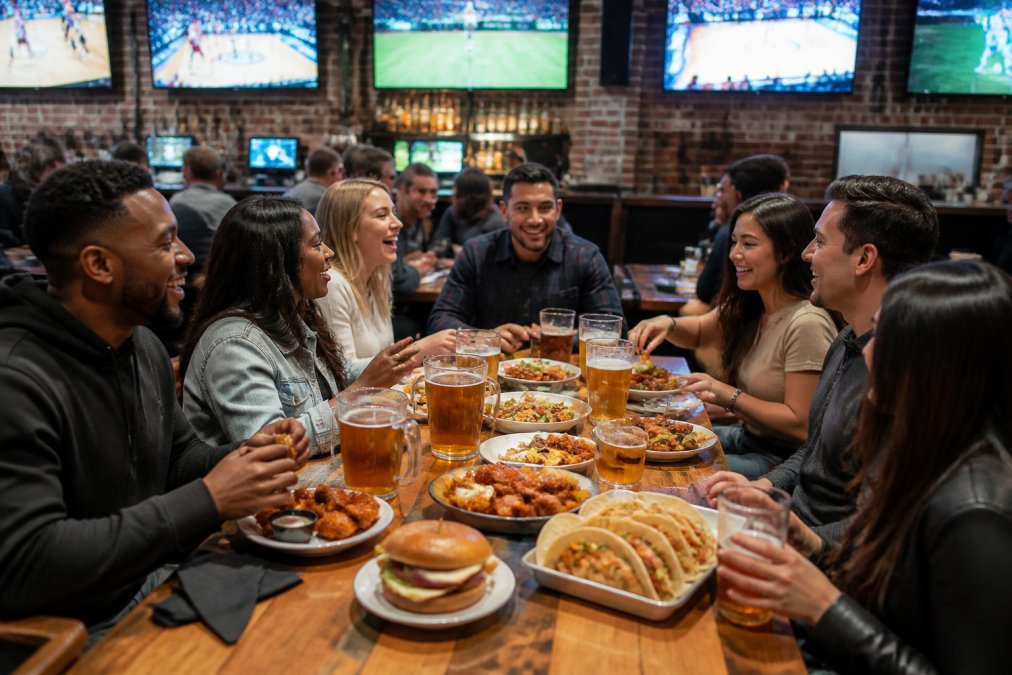
Planning a large group dinner event gets messy when the details live in your head. Crowne Sports Bar & Grill takes that weight off with a group-friendly space, big screens for game days, late-night eats, and a menu of wings, burgers, and tacos built for a crowd. Get started with Crowne Sports Bar & Grill and host your next group dinner without the last-minute scramble.